News
Corum Admiral All-Ceramic: The Manufacturing Realities Behind a Porthole Case in Sintered Material
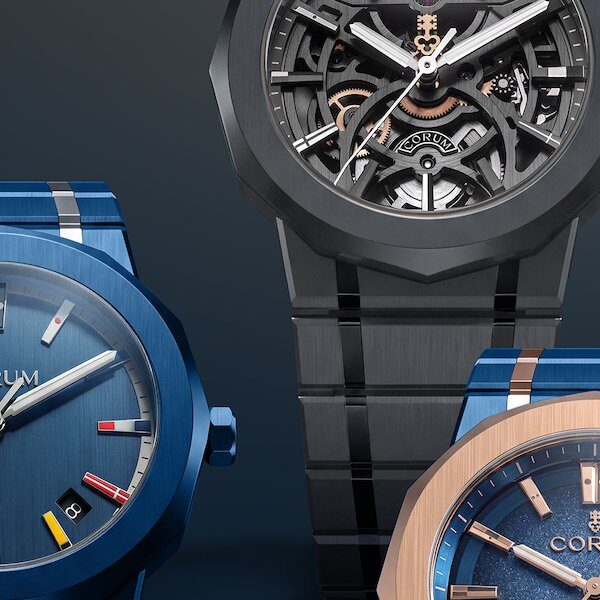
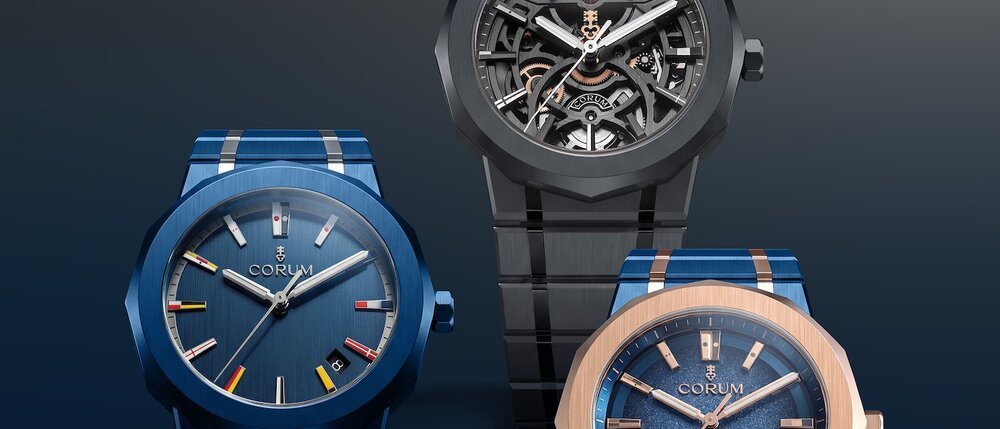
In October 2026, Corum confirmed what had been previewed at Geneva Watch Days earlier that year: the Admiral collection now exists in ceramic, and it does so across three distinct references simultaneously. A titanium blue version, a two-tone variant incorporating 5N gold, and a skeletonised model in anthracite ceramic. For component suppliers and case manufacturers, the announcement is less about the Admiral’s nautical heritage and more about what it takes to produce that specific porthole geometry — with its integrated bracelet, its 39 mm diameter, and its 8.90 mm thickness — entirely in sintered material.
Why the Porthole Case Complicates Ceramic Production
Ceramic’s appeal in case manufacturing is well understood: scratch resistance, dimensional stability, low thermal conductivity, and a surface that holds its finish over years of wear. What is less discussed openly is how unforgiving the material is when the geometry departs from simple cylindrical or flat forms. The Admiral case is not a simple round or cushion shape. Its porthole character involves compound curves, defined edges, and — critically for this generation — an integrated bracelet architecture that eliminates traditional lugs entirely. The bracelet flows directly from the case, which means the transition zone between case body and first link must be machined and finished as a continuous ceramic surface, not as a metal-to-ceramic junction that can be managed with a gasket or a bezel seat.
Sintering introduces shrinkage, and shrinkage is not perfectly uniform across a complex three-dimensional form. A case blank that enters the furnace at one set of dimensions exits at reduced size, and the reduction varies depending on wall thickness, local geometry, and the density of the green body. For a case that must ultimately measure 39 mm in diameter and 8.90 mm in thickness — and must mate precisely with a sapphire caseback, a crown tube, and a bracelet system — the pre-sintering geometry has to be calculated with enough margin to arrive at the finished dimension after shrinkage, without leaving so much material that post-sintering machining becomes prohibitively slow or risks fracture.
Post-Sintering Machining and the Limits of Diamond Tooling
After sintering, ceramic is machined almost exclusively with diamond-tipped tooling, and the process is slow by the standards of steel or titanium case production. The porthole form requires material removal on curved surfaces that transition between convex and concave radii, and maintaining consistent tool contact pressure across those transitions is where surface quality is won or lost. Any variation in feed rate or tool engagement introduces micro-chipping at edges — the same edges that will later be polished to a mirror finish or left satin-brushed depending on the reference.
The Admiral’s bracelet construction adds another layer of complexity. The five-link configuration — a satin-brushed centre link, two flanking polished links, and two outer satin-brushed links — requires that each ceramic link be individually finished to a different surface specification, then assembled with G5 titanium components (in the titanium blue version) or 5N gold elements (in the two-tone version). Holding the dimensional tolerances on individual ceramic links tightly enough that the assembled bracelet articulates without play, while also achieving the surface finish contrast that defines the bracelet’s visual character, is a quality control problem that sits squarely with the component supplier rather than the brand’s assembly team.
The Two-Tone and Anthracite Variants: Different Finishing Demands
The three references are not simply colour variants of the same manufacturing process. The two-tone model pairs ceramic with 5N gold, which means the case construction involves dissimilar materials with different hardness values meeting at defined interfaces.
The anthracite ceramic skeleton model presents a different set of demands. The CO232 calibre — the skeletonised variant of the CO231, comprising 181 components against the CO231’s 172 — is visible through the dial side as well as the sapphire caseback. That means the case must be finished to a standard that holds up under direct visual inspection from both faces. The anthracite ceramic interacts with light differently than titanium blue, absorbing rather than reflecting, which tends to make surface inconsistencies more visible rather than less.
Movement Integration at 8.90 mm
Both calibres — the CO231 and CO232, developed entirely with Concepto, the movement manufacture owned by Corum — beat at 4 Hz (28,800 vph) and deliver a 72-hour power reserve. The CO231 carries 29 jewels; the CO232, 28. Fitting either movement into a ceramic case that measures 8.90 mm in total thickness requires that the movement height, dial stack, and caseback all be managed within a tolerance envelope that leaves no room for the kind of minor case-height adjustment that is routine in steel construction. Ceramic cannot be skimmed at the bench. If the case arrives from the supplier outside tolerance, it is scrap.
That reality — scrap rather than rework — is the central manufacturing discipline that ceramic imposes on the entire supply chain. It raises the stakes on every upstream decision, from powder composition and binder selection through sintering profile and post-sintering inspection. For suppliers working with Corum on the Admiral programme, the three-reference simultaneous launch means three distinct finishing specifications, two movement variants, and two bracelet material combinations, all held to the same dimensional standard. That is a meaningful qualification exercise, and the results will inform how the Admiral platform develops from here.