Design
Oris ProPilot Bronze: Alloy Behaviour, Patina Control, and the Machining Realities of a Copper-Based Case
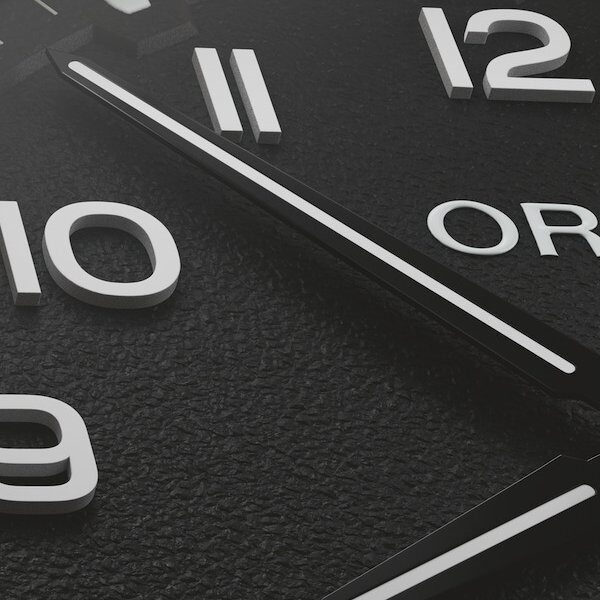
The Oris ProPilot Bronze, introduced in September 2026, is built around a 41 mm multi-piece bronze case — 49 mm lug to lug, 11.70 mm thick, with an interhorn width of 20 mm. Those are conventional pilot-watch proportions. The material is not conventional at all, and for a component manufacturer supplying case parts or finishing services, bronze demands a fundamentally different approach at almost every stage of production.
Why Bronze Behaves Differently on the Machine
Stainless steel — the default case material across the industry — is predictable under cutting. Its work-hardening characteristics are well understood, tooling wear rates are established, and coolant strategies are mature. Bronze alloys containing copper, tin, and aluminium behave differently in each of those respects. Copper-rich alloys tend to be softer and more ductile than austenitic steels, which sounds like an advantage until you consider what that means for surface finish: the material smears rather than shears cleanly at the cutting edge, producing built-up edge on carbide tooling and leaving a torn, rather than machined, surface texture if feeds and speeds are not carefully tuned.
The aluminium content in the alloy — present to improve corrosion resistance and mechanical strength — raises the hardness relative to a simple copper-tin bronze, which partially mitigates the smearing problem but introduces its own complications. Aluminium bronzes form a tenacious aluminium oxide layer at the surface during machining, analogous in some ways to the passive layer on stainless steel but less predictable in how it interacts with cutting geometry. Toolpath strategy matters enormously: climb milling is generally preferred to reduce rubbing, and cutting depths need to be managed to avoid work-hardening the subsurface layer in ways that will telegraph through to the final finish.
The ProPilot Bronze case is described as multi-piece, which means the case middle, bezel, and caseback are produced as separate components and assembled. The bezel carries the ProPilot’s signature fluted profile — a turbine-inspired geometry that requires precise radial indexing and consistent depth of cut across each flute. In stainless steel, that geometry holds well because the material springs back predictably. In bronze, the softer matrix means that any variation in clamping force or fixture rigidity will show up as dimensional inconsistency between flutes. Fixturing for bronze case components needs to be stiffer and more precisely located than equivalent steel work, not less.
Surface Finishing and the Patina Question
Oris is explicit that the ProPilot Bronze will oxidise over time, and that this is intentional — each piece’s profile will change as the metal oxidises, while its base features remain. From a finishing standpoint, that framing has real engineering implications. The goal is not to prevent oxidation but to ensure that the oxidation that does occur is uniform, controlled, and aesthetically coherent rather than patchy or structurally damaging.
That starts with the pre-delivery surface condition. Bronze responds to polishing and brushing differently than steel: it burnishes more readily, and a high-polish bronze surface will develop patina at a different rate and with a different colour progression than a brushed or satin-finished one. If the case carries mixed finishing — polished flanks alongside brushed surfaces, for instance — the two zones will oxidise at visibly different rates, which may or may not be the intended effect. Controlling that outcome requires that the finishing process itself be tightly specified and consistently executed, with surface roughness parameters held to narrow tolerances across every component.
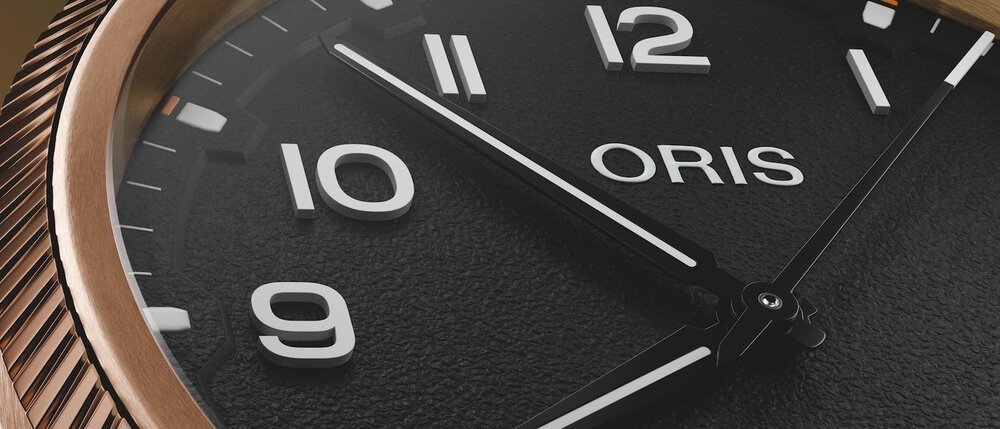
The caseback on the ProPilot Bronze is stainless steel with a screwed, see-through mineral glass construction — a deliberate material boundary that eliminates the galvanic corrosion risk that would arise from a bronze caseback in direct contact with the movement’s steel and brass components under humid conditions. That is a sound engineering decision. The crown and clasp, however, are bronze, meaning those components — which see the most mechanical wear and the most direct skin contact — need to be finished and, where appropriate, treated to ensure their oxidation behaviour matches the case rather than diverging from it.
Movement Integration and Quality Control
Inside the case sits Calibre Oris 733, a 25.60 mm diameter automatic movement running at 4 Hz (28,800 vibrations per hour) with a 41-hour power reserve and 26 jewels. It delivers hours, minutes, seconds, and date with instantaneous date change and a fine-timing device. The movement itself is not bronze-specific — it is a Swiss Made automatic calibre used across the ProPilot line — but its integration into a bronze case raises quality-control considerations that do not apply to steel.
Bronze cases expand and contract at a different rate than steel under thermal cycling, and the dimensional relationship between the case middle and the movement ring or movement holder needs to account for that. If the movement is located against a bronze surface, the fit that is correct at room temperature may be marginally different at the temperature extremes the watch will encounter in everyday use. These are small effects, but at the tolerances involved in movement seating and water resistance — the ProPilot Bronze is rated to 10 bar (100 m) — small effects matter. Gasket compression, crown thread engagement on the bronze screw-in crown, and caseback thread integrity all need to be validated against the specific thermal and mechanical properties of the alloy, not simply carried over from the steel-case specification.
The dark green suede strap with its folding LIFT clasp — the clasp itself in bronze — completes the assembly. The LIFT clasp’s seamless adjustment mechanism involves moving parts in bronze, which means wear surfaces need to be evaluated for the alloy’s tribological behaviour: bronze is generally a good bearing material, but fine adjustment mechanisms with tight clearances can be sensitive to the dimensional changes that accompany surface oxidation over time.
For suppliers and contract manufacturers, the ProPilot Bronze is a useful case study in what it takes to industrialise a corrosion-active material at production volumes. The engineering decisions visible in the specification — the steel caseback, the bronze crown and clasp, the controlled-oxidation finishing philosophy — reflect the kind of material-boundary thinking that separates a well-engineered bronze watch from one that simply looks good on launch day. As more brands explore non-standard case materials, the process knowledge required to execute them consistently is becoming a genuine differentiator at the component level.