Design
Rolex Inclined Plane Clock: What a Gravity-Driven Rolling Mechanism Demands from Precision Manufacturing
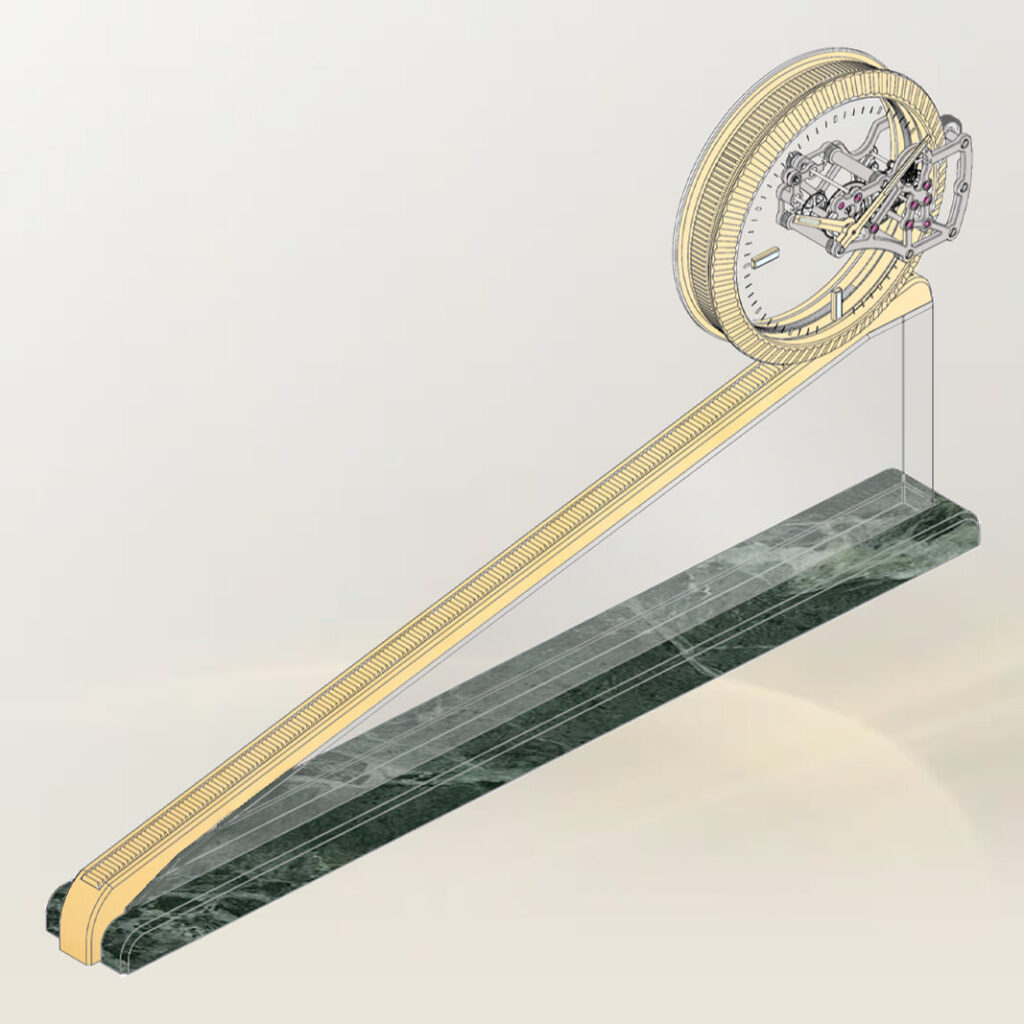
Rolex filed a design patent for an inclined plane clock, and prototypes were already present at Watches & Wonders 2026—one in the lobby of the Rolex stand, another in chief executive Jean-Frederic Dufour’s office. No photographs were permitted. What the patent filing does reveal, however, is enough to prompt a serious conversation about what this kind of mechanism actually requires from a manufacturer’s machining and finishing infrastructure.
The Mechanical Premise and Its Manufacturing Consequences
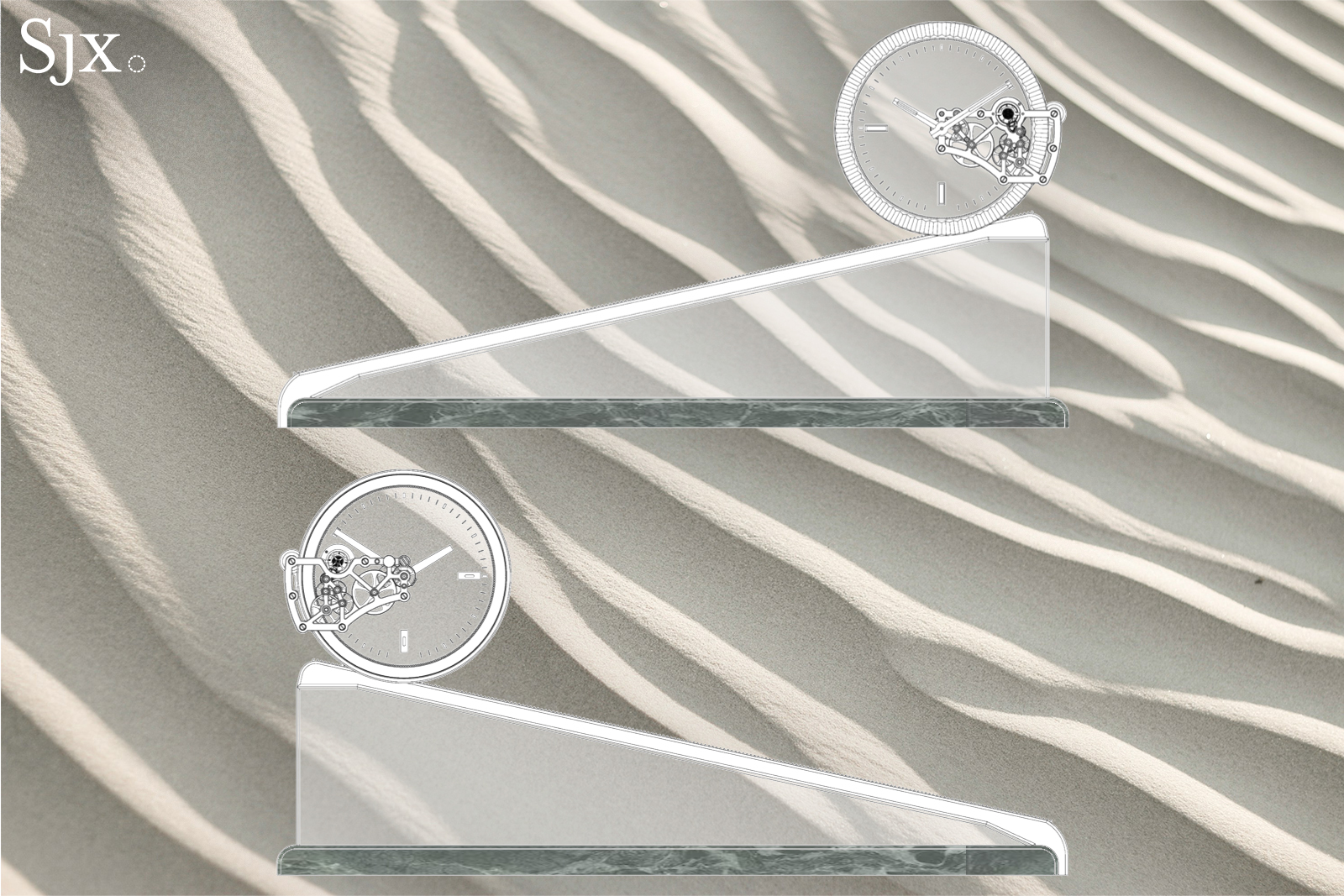
An inclined plane clock—sometimes called a gravity clock—has existed since the 17th century. The operating principle is straightforward: the clock rolls slowly down a sloped surface over the course of seven days, extracting motive energy from its own descent. At the end of the cycle, it is lifted back to the top and the process repeats. There is no mainspring to wind in any conventional sense. The energy source is gravitational potential, and the rate at which that energy enters the gear train is governed entirely by the escapement and the geometry of the incline.
That last point carries real manufacturing weight. In a conventional movement, a mainspring’s declining torque curve is a known variable that designers compensate for with remontoire systems, fusées, or constant-force mechanisms. In a gravity-fed system, the motive force is theoretically more consistent—the same total energy available on day one is available on day seven. But “theoretically” is doing a lot of work in that sentence. The counterweight that keeps the movement from rotating freely within the cylindrical case shifts its position incrementally with each escapement unlock. That shift moves the clock’s center of gravity, which initiates the roll, which in turn rotates the case counterclockwise and returns the counterweight to its starting position. Each cycle of this sequence introduces a brief, small perturbation in the force delivered to the escapement. Across seven days, those perturbations accumulate. Keeping them within a range that produces acceptable timekeeping requires the gear train to be machined and finished to tolerances that minimize frictional variance at every interface.
Rack and Pinion: Eliminating Slip, Introducing New Tolerances
Traditional inclined plane clocks use knurled bands on the case to grip the inclined surface—typically soft wood, felt, leather, or rubber—and prevent sliding. Rolex’s design replaces this with a rack and pinion system. The decision eliminates the unpredictability of a friction-based grip and removes the dependency on a specific surface material, but it substitutes a different set of demands. A rack and pinion interface requires consistent tooth geometry across the full length of the rack, and the pinion must engage without backlash or binding throughout the seven-day travel distance. Any variation in tooth pitch or depth translates directly into an irregular advance rate, which disrupts the uniformity of force delivery to the movement above.
Machining a rack to the precision required for a horological application—where the engagement must be smooth enough not to introduce detectable impulse irregularities—is not a trivial CNC operation. The tooth flanks need to be finished, not simply cut, and the mating pinion leaves must be polished to reduce friction at the point of contact. This is the kind of work that sits at the intersection of gear-cutting and decorative finishing, and it is where a manufacturer’s capabilities become visible in the final product’s performance rather than just its appearance.
The Skeletonised Movement and the Balance Orientation Question
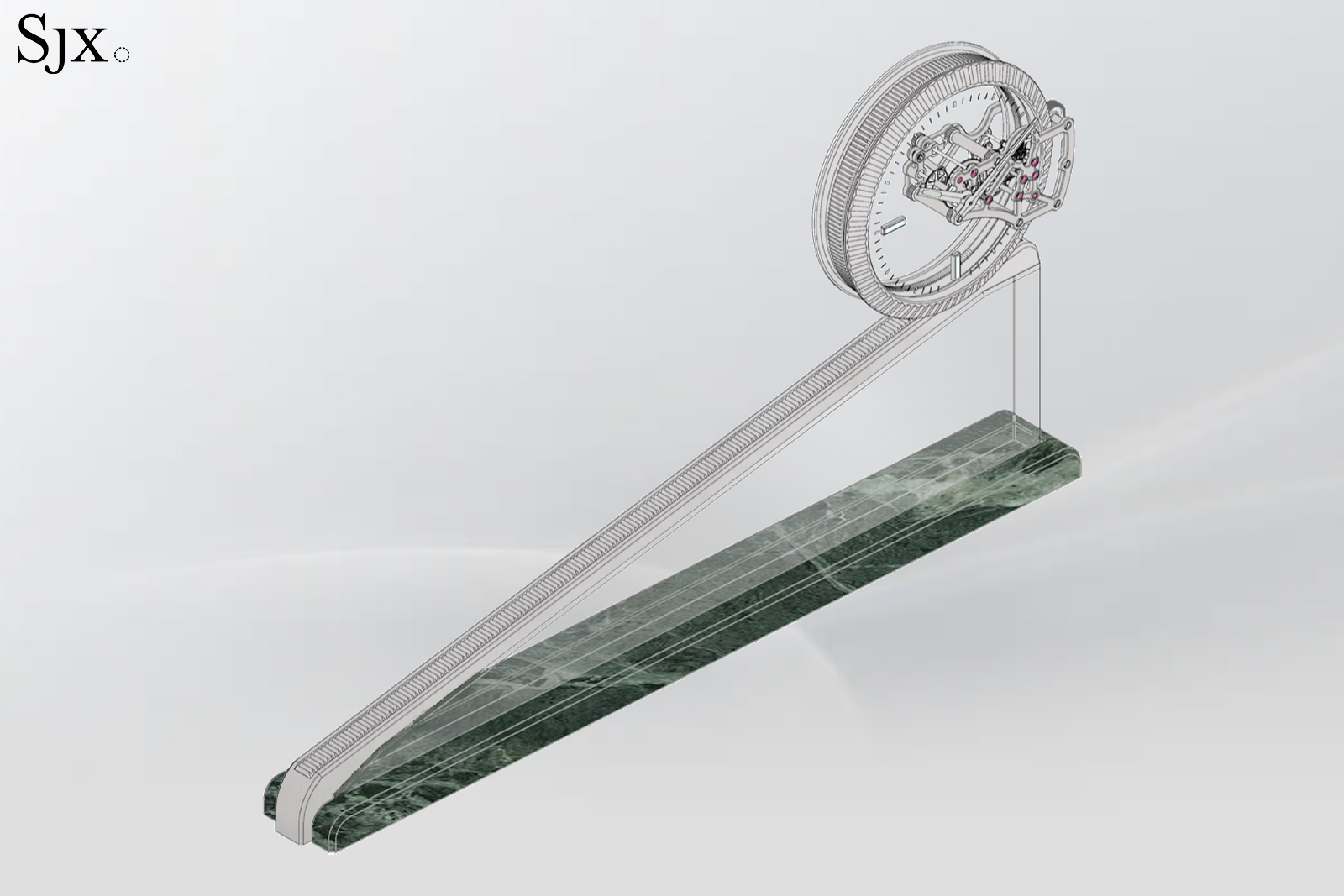
The movement is skeletonised—Rolex’s first skeletonised movement in a commercially available product. The patent filing, created by Rolex designer Vincent De Peyer, shows the Microstella balance wheel as a visible element. Skeletonisation in this context is not purely aesthetic. Removing material from bridges and plates while maintaining the structural rigidity necessary to hold pivot jewels in precise alignment is a machining problem. Every bridge that is opened up must be checked for deflection under the loads imposed by the gear train. The finishing work on skeletonised components—bevelling, anglage, and surface polishing on parts that are now visible from multiple angles—multiplies the labor content significantly compared to a closed-plate movement.
One detail in the design is worth noting from an engineering standpoint: the balance hangs vertically rather than horizontally. A horizontal balance, as used in chronometers and carriage clocks, reduces the positional error introduced by gravity acting on the balance staff and its pivots. A vertical orientation reintroduces those positional influences. For a mechanism whose primary claim is constant-force delivery via gravity drive, accepting a vertical balance orientation suggests that absolute precision is not the primary objective—visual legibility of the mechanism is. That is a legitimate design choice for a desk clock intended partly as a point-of-sale demonstration piece, but it does mean the movement’s rate performance will be more sensitive to the exact angle of the inclined plane and any minor surface irregularities in the rack.
The Maintaining Power Question
One unresolved manufacturing question concerns what happens at the moment of “rewinding”—when the clock is lifted from the bottom of the slope and repositioned at the top. During that transition, the gravitational drive is interrupted. Whether Rolex has incorporated a maintaining system to keep the escapement supplied with force during repositioning is not disclosed in the design patent. If such a system exists, it would almost certainly be the subject of a separate utility patent filing. A maintaining mechanism adds components, pivot points, and additional finishing surfaces to an already complex skeletonised architecture. Its presence or absence will say something concrete about the movement’s construction depth when the utility patent eventually surfaces.
The trademark application for the name “Haplos” was filed within weeks of the design patent, which suggests commercial release is a genuine near-term intention rather than a speculative project. For component suppliers and movement manufacturers watching this space, the rack and pinion drive system and the skeletonised architecture together represent a manufacturing brief that sits well outside Rolex’s established production vocabulary—and the execution details, when the clock reaches the market, will be worth examining closely.